
From 5-Year Roadmap to Reality: How AI is the Non-Profit Force Multiplier
The headlines warn about AI taking jobs. They're missing the more important story. For builders in the non-profit sector, AI isn't a threat — it's the force multiplier we've been waiting for. My own journey building PF TECH proves it.


The headlines are designed to grab attention: “AI Job Crisis,” “Robots Are Coming for Your Job.” This narrative focuses on displacement, but it completely misses the more exciting story: for builders, innovators, and problem-solvers, AI isn’t a threat; it’s the ultimate force multiplier.
It’s demolishing old barriers to entry and sparking a new wave of entrepreneurship, especially for those building specialized solutions for sectors like non-profits. My own journey building PF TECH is a direct testament to this.
The Five-Year Acceleration
Back in 2021, the concept for PF TECH was solid. But the standard playbook involved wrestling with inadequate, clunky software. Realistically, I was looking at a five-year slog of slow, expensive, iterative development.


Then the tech stack evolved. Accessible AI coding agents and sophisticated large language models changed the entire equation. Suddenly, I could fuse my backend and automation skills with powerful front-end development capabilities.
An integrated stack of AI coding agents, automation tools, and workflow engines became my development team. AI compressed a five-year roadmap into a present-day reality.
The New Economics of Creation
The impact on PF TECH’s bottom line is not just significant; it’s transformative. This new paradigm of AI-assisted development fundamentally changes the math for building sophisticated tech.

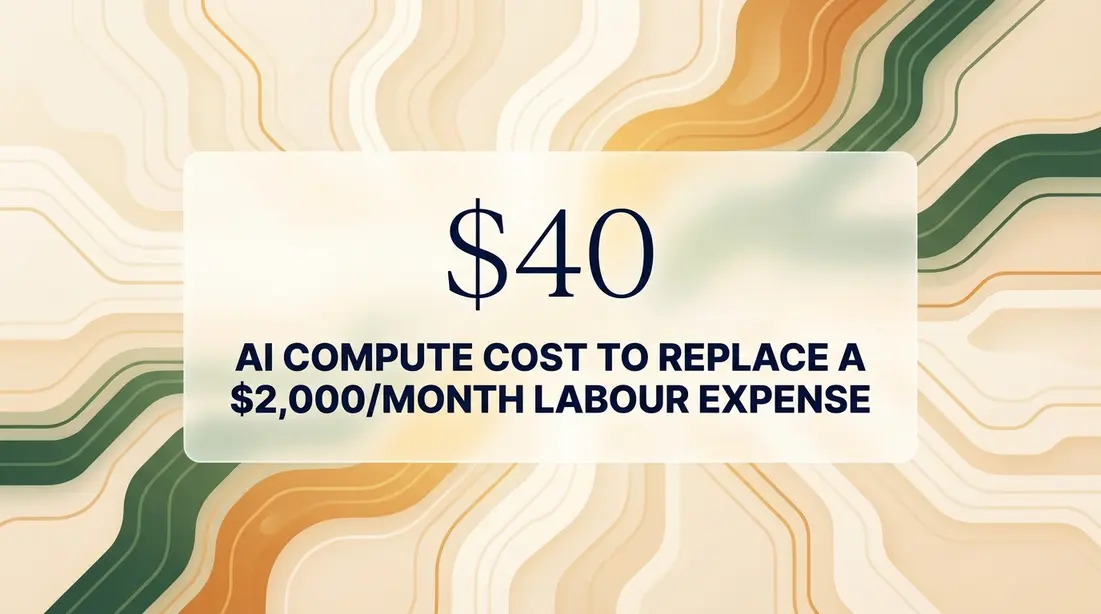
Operational savings: In the early days of building PF TECH’s first Strategic Partnership, the organization’s Operations Lead was spending days each month creating manual planning calendars — a $2,000/month labour cost hidden inside administrative overhead. Using AI, I built a custom, dynamic planning tool in under eight hours for less than $40 in compute costs.
Rapid deployment: A core data integration that used to take two full weeks to configure can now be deployed in a single day. Same outcome. A fraction of the time and cost.
Web development: Full websites built in under a week for less than $100 in AI compute. The estimated savings on upfront design and development costs exceed $10,000.
The Complexity Paradox
As the founder of PF TECH, I’m energized. AI has enabled me to build solutions I’m passionate about now, without the five-year delay.
There is a paradox worth naming, though. While the macro system of AI grows more complex, it allows us to radically reduce the complexity of our day-to-day tech stacks. We can replace a dozen disparate tools with one streamlined, intelligent platform. This trade-off — exchanging systemic complexity for operational simplicity — is what makes this revolution so compelling for builders.
For the non-profit sector specifically, this matters more than anywhere else. Organizations that have been told for decades they can’t afford proper technology infrastructure are discovering that the economics just changed. The question isn’t whether your organization can afford to build better systems anymore. The question is whether you have the knowledge to start.
Ready to compress your own roadmap?
The Mission Multiplier Program is a structured cohort for non-profit finance staff and operations leaders who want to stop watching the AI wave from the shore and start building with it.
Join the MMP WaitlistAbout the author
Greg Zatulovsky, CPA
Founder & CEO, PF TECH · 15+ years in non-profit finance, operations & technology
Greg founded PF TECH to give Canadian non-profits access to the same operational infrastructure as the private sector — without the overhead. He writes about AI adoption, financial management, and the practical realities of running a mission-driven organisation.


