
AI, Data Sovereignty, and the Modern Tech Stack
The public debate about AI risk focuses on deepfakes and headline threats. The more empowering story gets buried: AI is the most powerful tool we have for actually achieving data sovereignty. Here's how I used it to rebuild our entire tech stack on our own terms.


The public conversation around AI risk is dominated by hypotheticals and headline-grabbing threats like deepfakes and data scraping. While these are valid concerns, they shadow a more immediate and empowering reality for businesses and their tech leaders: AI is the single most powerful tool we have for achieving true data sovereignty.
For too long, we’ve been forced to accept a fragmented, high-risk tech stack. It’s time to use AI to rebuild it on our own terms.
The SaaS Sprawl: A Technical Debt Nightmare
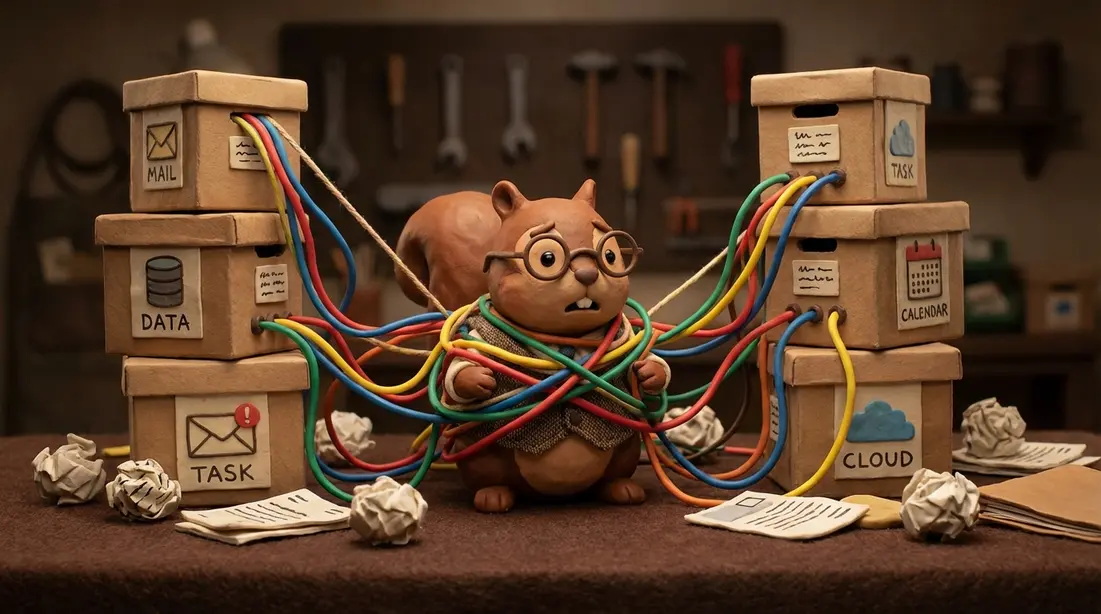
Take a look at the typical small business tech stack. It’s a Frankenstein’s monster of SaaS applications. Project management lives in one silo, customer data in another, and financial information is passed between systems via a fragile web of third-party connectors.
This isn’t just inefficient; it’s a massive security vulnerability. Every app, every connector, is a potential point of failure. The average cost of a data breach for a small business is staggering, often stemming from a single compromised credential in a third-party cloud app.

How AI Became My Ally for Data Control
This is where the narrative shifts. I’ve made a strategic decision to leverage AI as my primary tool to dismantle this fragmented system and reduce my reliance on opaque third-party platforms.
Instead of routing critical financial data through black-box connectors, I’ve used AI as a development partner to build my own custom API connections with the open-source automation tool n8n. Our most sensitive data now resides in Supabase, which utilizes enterprise cloud infrastructure but — and this is the critical distinction — allows me to enforce data residency in Canada.
For a Canadian organization, this is a non-negotiable win for data sovereignty and compliance with privacy laws like PIPEDA, which carry significantly stricter expectations than those in many other jurisdictions.
AI also provided the technical leverage I needed to overcome my reservations about self-hosting. AI tools act as expert research assistants and real-time troubleshooters, giving me the confidence to evaluate self-hosted infrastructure options on their merits — not avoid them out of fear of complexity. The result: dramatically reduced surface area of data exposure to third parties.
The Open-Source Advantage: More Than Just Code
My strategic shift towards open-source tools is also a philosophical one. Frankly, I don’t trust the tech oligopoly to act in my best interest. The open-source ecosystem is fundamentally different. It’s built on community, transparent code, and a shared commitment to solving real-world problems.

We’ve deliberately selected tools from companies based in jurisdictions with robust data privacy laws — Germany (n8n), for instance — because their corporate values align with our technical and ethical requirements. At the end of the day, I’d rather build our stack on a foundation of trust and shared principles.
First Steps Toward Reclaiming Your Data Stack
For any organization, AI offers a counter-intuitive but powerful path to better control over sensitive data. It’s a strategic choice that requires intention.
If you’re a leader looking to take this seriously, here are two practical first steps:
- Conduct a tech stack audit. Inventory every application your team uses. For each one, ask: What is their data breach history? Where is the company headquartered? Most importantly, where is my data physically stored? If this information isn’t easily accessible, that’s a major red flag.
- Prioritize open-source alternatives. When evaluating a new tool, actively search for open-source options. You don’t have to self-host everything — many offer cloud versions that still benefit from a company culture built on transparency and data privacy.
Ultimately, not every organization can become a cybersecurity operation. True protection will require better regulation. But we aren’t helpless. AI gives us the tools to engineer a more secure, sovereign foundation right now.
Concerned about your organization's data architecture?
PF TECH's AI & Data Governance Advisory helps non-profit leadership teams audit their current tech stack, establish data residency policies, and build AI governance frameworks that protect the people they serve.
Explore AI Governance AdvisoryAbout the author
Greg Zatulovsky, CPA
Founder & CEO, PF TECH · 15+ years in non-profit finance, operations & technology
Greg founded PF TECH to give Canadian non-profits access to the same operational infrastructure as the private sector — without the overhead. He writes about AI adoption, financial management, and the practical realities of running a mission-driven organisation.
You might also like

TERN: Engineering a Unified Data Ecosystem for Non-Profits
Feb 11, 2026 · 5 min read

The Maker's Revolution: From Concept to Code Without the Bloat
Feb 11, 2026 · 5 min read

From 5-Year Roadmap to Reality: How AI is the Non-Profit Force Multiplier
Feb 11, 2026 · 4 min read